
Regen Melbourne acknowledges and respects the Bunurong, Boon Wurrung and Wurundjeri Woi Wurrung peoples of the Eastern Kulin Nation, which is now known as Melbourne. We extend these acknowledgements to all Traditional Owners across the State of Victoria. The knowledge, practices and deep wisdom of the First Nations people of this land guides, informs and drives our work.
It has been a while since our last edition, with a busy few weeks on the streets. This means that we have lots of juicy content for the street library. And since we’re kicking into end of year mode with parties to boot, we’re offering up more reading, listening and watching and less things to go along to so you can spend precious time with family and friends.
This month’s reading shows some promising shifts in policy and funding, some inspiring examples of regenerated streets in global settings, some fun public space analysis from our recent Melbourne Amyl and the Sniffers non-event and much love for the street tree. You can also enjoy a detailed story of the evolution of the green, community-rich Guildford Lane. “It has nothing to do with the plants,” Katherine explained. “It was the intersection of the plants as a project that the community did together.”
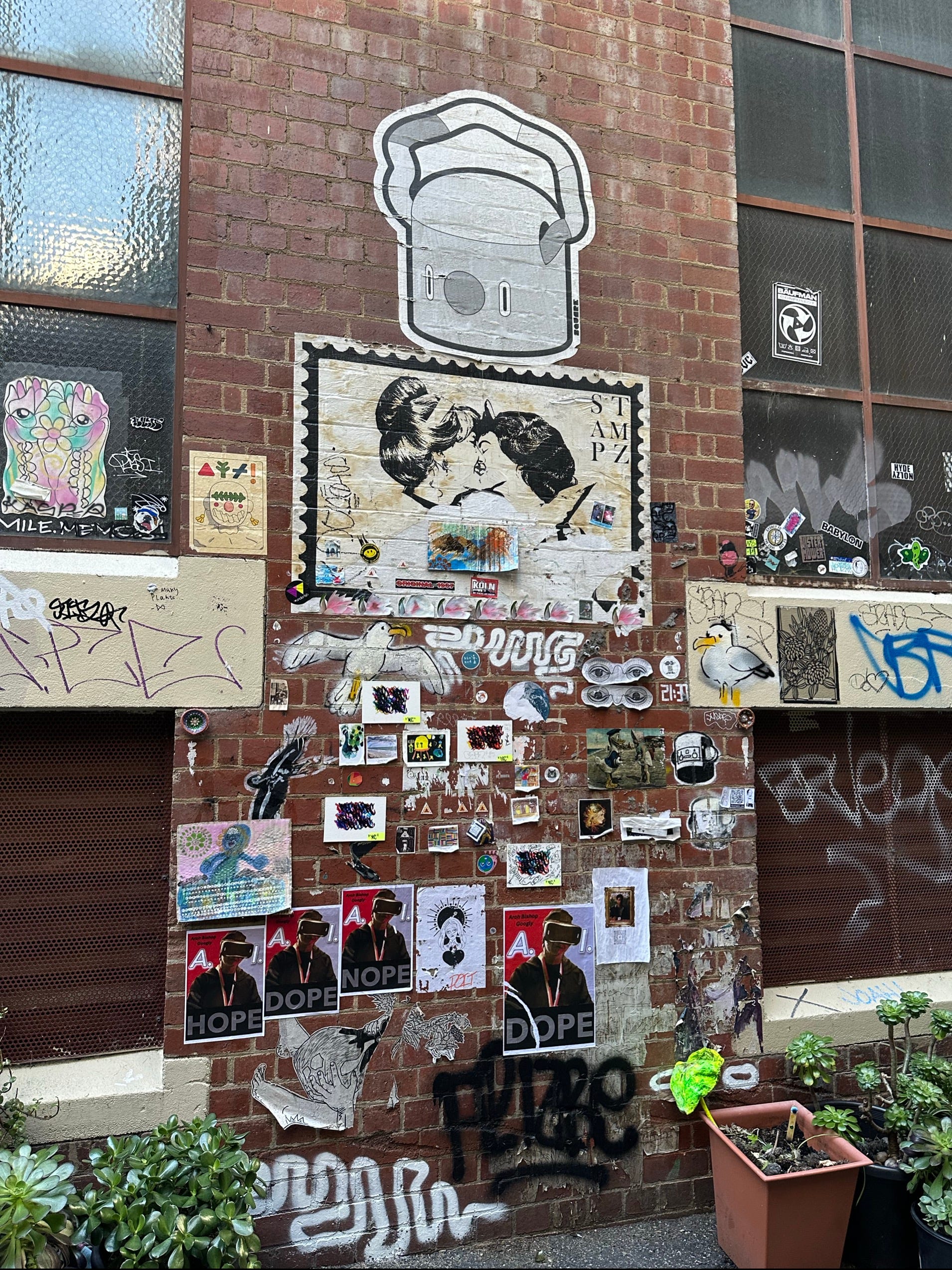
🔄 Melbourne Shifts
More funding for bikes? Yes please! Melbourne’s inner councils will have $15 million more funding for bike projects each year following amendments to the Victorian Congestion Levy legislation. Levy funds will be redirected to 5 inner city councils for spending specifically on active travel. 🥳
Active transport funding boost
📚 Many Things to Read
1. Speed Limits: What Changes and What Doesn’t
🚗 Why it matters: This article tells us what it would mean, and what it wouldn’t mean, to reduce speed limits across the city. Essential reading as we consider how we make trade offs and the implications of these - perceived or otherwise.
✨ Highlight: Reducing speeds from 50km/h to 30km/h dramatically improves cyclist safety while adding minimal time to car journeys, challenging the assumption that slower speeds mean significantly longer commutes.
2. Fighting for Fed Square’s Soul
📄 From Apple to Amyl: Fighting for the Soul of Federation Square
🎭 Why it matters: What do we want? Civic spaces! Free public events! More Amyl and the Sniffers! When do we want it? Now! This piece explores what makes public spaces truly public and worth fighting for.
✨ Highlight: The battle over Federation Square demonstrates how communities can successfully mobilise to protect civic spaces from commercial interests and keep them accessible for cultural expression and public gathering.
3. Active Commutes and Cancer Prevention
📄 Study finds active work commutes lower cancer risk
🚴 Why it matters: New study shows cycling or walking to work will significantly reduce the risk of several forms of cancer as powerful evidence that how we get around directly impacts our health.
✨ Highlight: Active commuting isn’t just good for the planet and our communities; it’s a daily investment in personal health that can substantially reduce cancer risk across multiple types.
4. Tree First Paradigm Shift
📄 ULI Net Zero Imperative TAP - Victoria
🌳 Why it matters: ULI Net Zero Imperative TAP recommends a Tree First paradigm shift to effectively prioritise street trees recognising that trees are infrastructure, not decoration.
✨ Highlight: Putting trees first in street design creates multiple co-benefits: shade, cooling, stormwater management, and community wellbeing, all while supporting net zero targets.
5. New Civic Frameworks for Climate Action
📄 Centre for Urban Research, RMIT
🏙️ Why it matters: The Centre for Urban Research at RMIT tells us that to act on climate change, we need new civic frameworks. Not just technical solutions but transformative, place-based and regenerative learning practices.
✨ Highlight: Climate action requires more than technology; it demands new ways of engaging communities and reimagining how we learn together to create regenerative urban environments.
6. Should Councils Subsidise Verge Gardening?
📄 Should councils subsidise verge gardening?
🌱 Why it matters: Our streets friend from Brisbane asks, should councils subsidise verge gardening? An important question as we consider how to support community-led greening initiatives.
✨ Highlight: Verge gardens provide public benefits in the form of greenery, biodiversity and community connection. This raises the question of whether councils should financially support residents who create and maintain these street-facing spaces.
7. What It Means to Be Civic Minded
📄 Erica picks up litter when she walks her dog
💝 Why it matters: A great post on what it means to be civic minded. It’s not as complicated as you think, sometimes it’s as simple as picking up litter on your daily walk.
✨ Highlight: Civic mindedness doesn’t require grand gestures; it’s the accumulation of small, everyday actions that demonstrate care for shared spaces and community wellbeing.
8. Shaping How We Live Well Together
📄 Greater Manchester Participation Playbook
🤝 Why it matters: A playbook from Greater Manchester that might just hold the key for how we shape living well together. By chance, some of the Greater Manchester folks recently visited Greater Melbourne to exchange ideas on city-shaping.
✨ Highlight: This comprehensive guide offers practical frameworks for meaningful community participation, showing how different cities can learn from each other’s approaches to building collaborative urban futures.
9. Communities as Co-Developers
📄 Communities as Co-Developers: Cultural Production as Urban Infrastructure
🏘️ Why it matters: A wonderful piece that explores communities as co-developers, cultural production as urban infrastructure and offers some insightful policy recommendations on how we might build a framework for community-led development.
✨ Highlight: When we recognise cultural activity and community organising as infrastructure rather than amenity, we open up new possibilities for supporting and resourcing grassroots urban development.
👁️ 4 Things to see and hear
1. Street Regeneration Visual Atlas
📸 Why it matters: A visual depiction of examples of street regeneration from across the globe. #inspo
✨ Highlight: Sometimes the best way to imagine what’s possible for our streets is to see what others have already achieved. This atlas provides endless inspiration for street transformation.
2. Global Streetscape Transformations
🎬 Why it matters: Street Films shows us how many global cities have already transformed their streetscapes. The amazing footage captured makes you feel as though you are walking the streets yourself. #moreinspo
✨ Highlight: Seeing streets transformed from car-dominated corridors to vibrant public spaces helps us envision what’s possible in our own neighbourhoods.
3. Finding What’s Strong in Community
📄 Asset-Based Community Development
💪 Why it matters: Cormac Russell invites us to find what’s strong within community rather than what’s wrong. A powerful reframing of how we approach community development.
✨ Highlight: Asset-based community development starts by recognising existing strengths, skills, and connections rather than focusing on deficits, creating a foundation for sustainable, community-led change.
4. Regenerative Streets Podcast
📄 Regenerative Streets Podcast - Episode 1
🎙️ Why it matters: Exciting new and very relevant podcast — Regenerative Streets. Which also happens to have me as the first guest!
✨ Highlight: This new podcast explores how we can move beyond sustainability to create streets that actively regenerate ecosystems, communities, and urban environments. Can’t wait for future episodes!
🌟 Streetlight on Place
Guildford Lane
I have been fortunate enough to spend a lot of time with the wonderful community of Guildford Lane of late and hear the stories of greening the laneway to make it the beautiful, shared public space that it is.
I have also been fortunate to work with a group of students from Monash University who have been busily interviewing some local and global examples of regenerated streets. I’ll share these on the Street Library over time, starting this edition with Guildford Lane.
Much gratitude to the wonderful students!
The Greening of Guildford Lane: How Residents Transformed a Forgotten Melbourne Street.
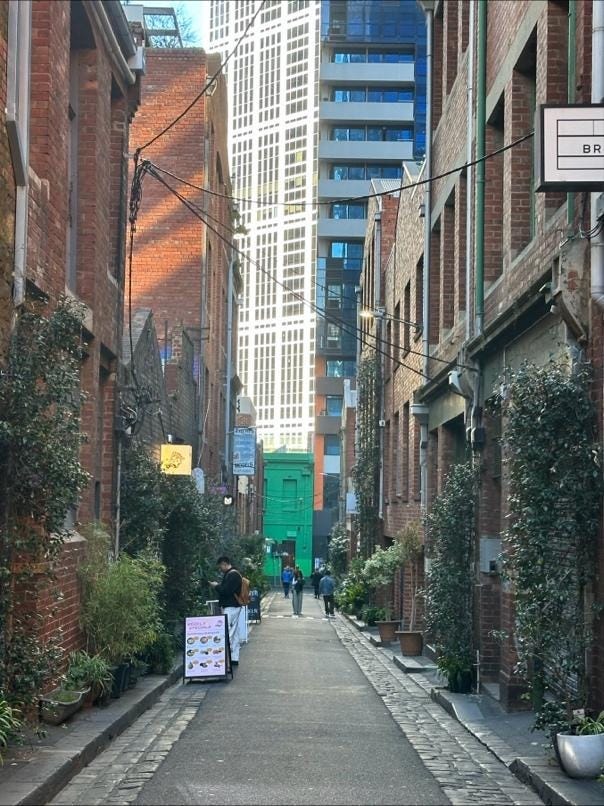
The greening of Guildford Lane in Inner Melbourne is an inspiring story of resilience, collaboration and vision. What began as one resident’s modest experiment in the early 2000s has grown into a community-led transformation that demonstrates both the possibilities and the challenges of regenerating urban spaces for people and nature.
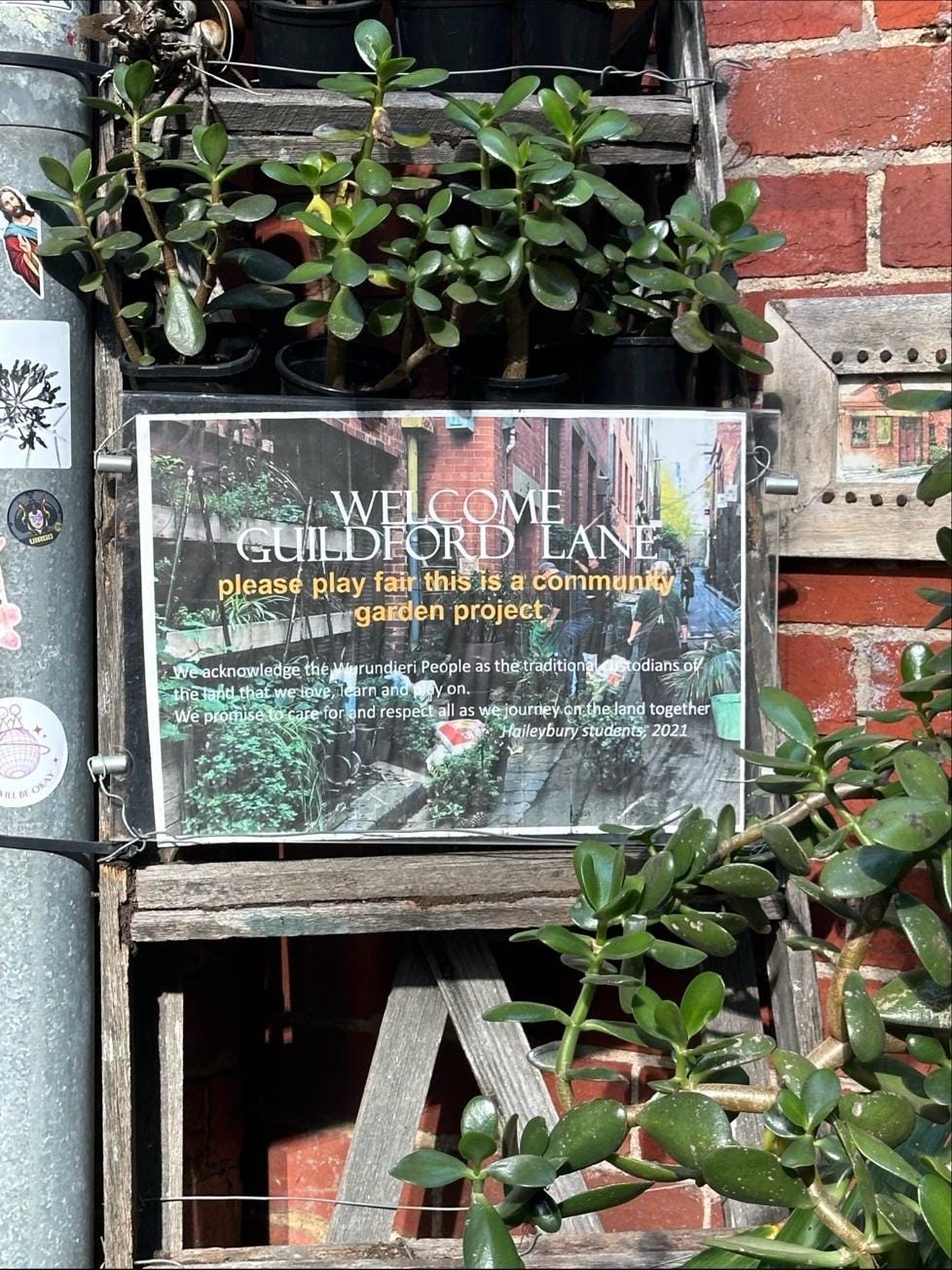
How it all began
Guildford Lane’s first attempt at greening began around 2000. A local champion, Katherine, brought some plants from her home in South Melbourne and planted them along the laneway. A few days later, the plants were stolen. She then planted geraniums in the heavy, difficult-to-move discarded pots. Visible results were soon apparent; passersby stopped to admire the colour and vitality these plants brought to the street.
Back then, the alley was far from the cultural hub it is today. It was filled with motorcycle repair shops, art galleries, and warehouses. Cafes and pedestrians were few and far between, and the environment seemed desolate. However, the presence of greenery hinted at the alley’s immense potential.
Over the years, high-rise construction in the surrounding neighbourhood caused numerous inconveniences, prompting residents to move away. When they returned around 2015, development had slowed, and the environment had become more livable. This return marked a turning point. With the help of neighbours and landowners, residents began reintroducing greenery with greater motivation and purpose. It marked the beginning of a long greening journey for Guildford Lane, growing from an individual effort into a community-led transformation.
“It has nothing to do with the plants,” Katherine explained. “It was the intersection of the plants as a project that the community did together.”
Facing the challenges
The City of Melbourne soon recognised the potential of laneway greening and launched a program to identify a pilot project. Guildford Lane gained overwhelming community support and was selected. However, the reality of working with the council was complex. Insurance requirements, infrastructure approvals, and cross-departmental consultations slowed progress.
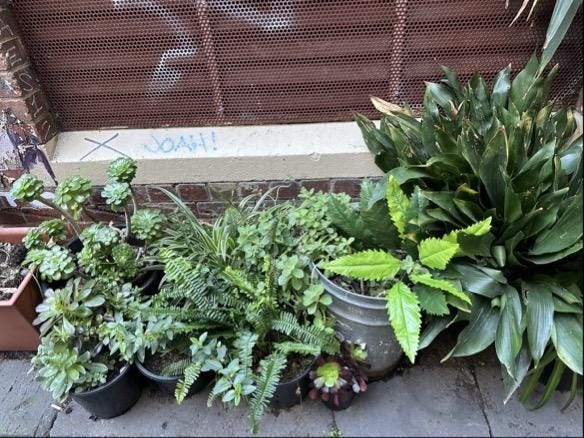
When the greening effort began, many residents were disappointed with the scale of the effort. However, unwilling to accept limited results, the community mobilised. They donated money, sourced plants, and supplemented the City Hall’s efforts with their expertise in architecture, design, and construction. Local businesses also contributed, with donations, while neighbours organised activities like drawing classes and storytelling to strengthen connections.
Katherine’s perspective
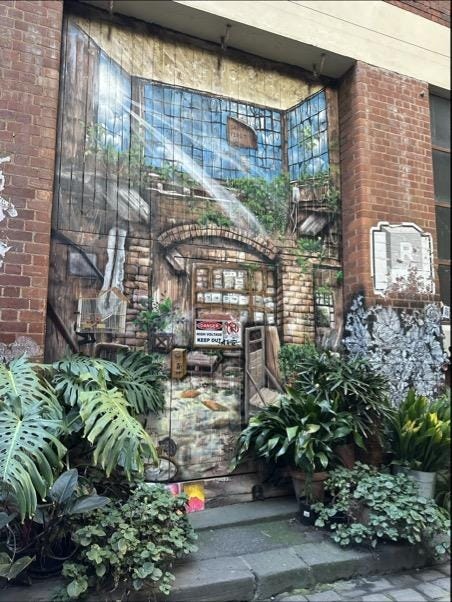
One of the driving forces behind the community, Katherine, a resident, believes greening is more than just a beautification project. To her, the plants are simply vehicles for a greater purpose. “The plants were just the excuse - what mattered was that we were doing something together as a community,” Katherine reflected.
Katherine is known for her inclusive approach, encouraging neighbours to contribute whatever they can. This approach has transformed small initiatives into transformative changes across the entire street. The greening project is credited with not only improving the aesthetics of the area but also fostering a sense of pride and trust among residents.
A vision for the future
Even with these challenges, the project’s impact is significant. Plants now provide shade, soften the built environment, and create a green oasis in the heart of the city. During the COVID-19 pandemic, the alley’s greenery has provided comfort and connection for residents who are isolating.
Looking forward, Katherine hopes the project will inspire others. “I wish other people would take up the lane and see the potential,” she says.
The community’s vision was clear, expanding participation, garnering greater support from businesses and beneficiaries, and ensuring the City of Melbourne’s continued role. This was achieved not only through greenery but also by promoting cultural activities and reducing bureaucratic barriers. Residents also recognised the need for a stronger organisational structure to maintain momentum and safeguard the lane’s vitality for future generations.
The transformation of Guildford Lane shows that even small actions like planting a flower, donating a pot, or sharing a skill can have a greater impact. What began as a personal experiment has become a shared asset, sustainably fostering the growth of both plants and the community.
🚶 Got an idea, story, or initiative that reshapes how we think about streets, community, or regeneration?
We’d love to hear it! Whether it’s a local project, cutting-edge research, or a spark of inspiration, share it with us to feature in our next edition. Let’s amplify your vision together! 🌟
Send us an ✉️ at nina@regen.melbourne